

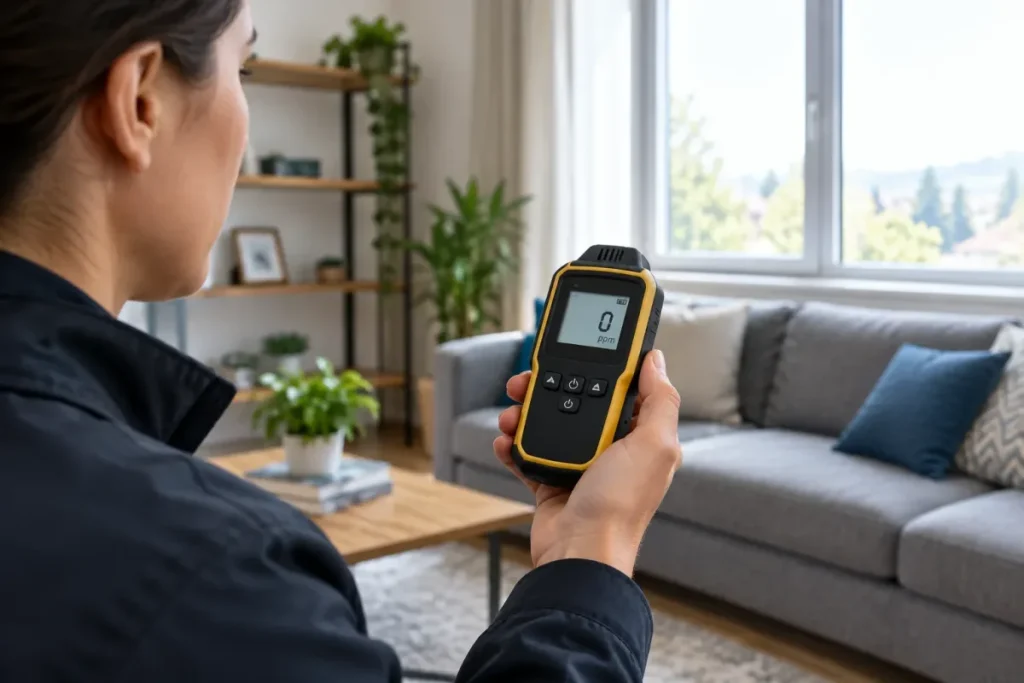
Use a suitable ambient CO meter to measure carbon monoxide in room air, not the concentration inside a flue. Record instrument status and the location/time of each reading, but do not wait for a measurement campaign if exposure is suspected: leave the area, seek fresh air and contact emergency services or qualified responders according to local instructions.
Ambient CO alarms are not equivalent to flue-gas measurements
A combustion analyzer can measure CO in a concentrated exhaust sample, whereas an ambient CO detector is designed for the surrounding air and may use different ranges and response methods. Never connect an ambient-air detector to a flue sample. Follow emergency procedures for a suspected exposure; a handheld survey does not replace a permanently installed life-safety alarm. For a deeper explanation of exhaust measurements, see flue gas analyzer readings explained.
Ambient CO and combustion-gas CO are different tasks
An ambient meter is designed for air occupied by people. A flue-gas analyzer operates in hot combustion exhaust with different sampling hardware and ranges. The same unit label—ppm—does not mean the two devices are interchangeable.
Basic service survey
- Confirm that the instrument is intended for ambient carbon monoxide and is within its service/calibration period.
- Follow manufacturer instructions for powering on, self-test, alarm settings and sensor response.
- Begin in a known safe area; enter suspected contaminated spaces only under an approved professional safety procedure.
- Measure at specified locations and record concentration, time, source activity and ventilation condition.
- Investigate potential combustion or ventilation faults through qualified professionals rather than disabling alarms or gas safeties.
How to interpret numbers
A display of 0 ppm does not guarantee that no intermittent source exists. Short-term peaks may occur under different burner, exhaust-fan or weather conditions. Conversely, an elevated reading cannot be dismissed because no one smells anything: CO is odorless. Applicable occupational and residential alarm thresholds have different purposes and must be sourced from the relevant governing standard.
Hypothetical example: why time matters
Hypothetical: a room reading rises from 2 ppm to 18 ppm as equipment starts and returns to 3 ppm after it stops. The peak is 16 ppm above the initial reading; this pattern warrants investigation, not a claim that 18 ppm is universally safe or unsafe. Immediate response must follow the instrument alarm and applicable emergency protocol.
Testo CO instrument
The testo 317-3 is an ambient CO meter with audible/visual alarms and a published 0–1999 ppm measuring range. Its self-check does not replace required calibration, and it is not a permanent, code-compliant household CO alarm unless independently certified and installed for that role.
Typical measurement limitations
| Issue | Why it matters |
|---|---|
| Unverified sensor condition | Response or accuracy may be degraded |
| Single spot measurement | May miss intermittent emissions |
| Sampling near vents or drafts | Can dilute or concentrate local readings |
| Wrong instrument class | Flue-gas and ambient-air requirements differ |